Costume of the Italian Peninsula, 1581
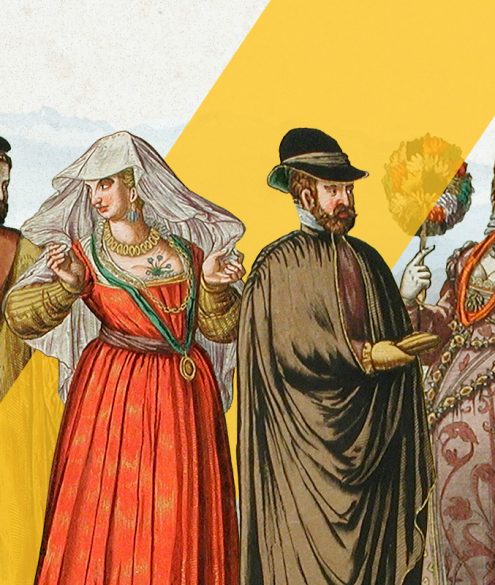
A journey through the clothing of the Italian peninsula at the end of the 16th century — from Rome and Venice to Padua, Florence, Siena, Milan, Bologna, Ferrara and Pisa.

Category
A journey through the clothing of the Italian peninsula at the end of the 16th century — from Rome and Venice to Padua, Florence, Siena, Milan, Bologna, Ferrara and Pisa.

European — mostly European — costume of the 1570s in drawings by Lucas de Heere, also known as Lucas d’Heere (1534–1584).

European Men’s Hairstyles and Headdresses of the 16th Century. 1500–1599. Year by Year Note on Regional Styles Although the portraits in this collection are arranged in chronological order, fashion and hairstyles varied greatly across countries and regions.

The Tudor bonnet, also known as the Renaissance flat cap or Renaissance bonnet, and sometimes simply (though inaccurately) called a “beret,” was a popular head covering in Renaissance Europe.

Baby rattle (rock crystal, coral and bells) is an accessory for infants that combined several functions: a rattle, a teether, sometimes a pacifier, quite often a whistle, and it also served as a protective charm.

Ice skating was already known in Europe during the Middle Ages: written sources from the 12th–14th centuries mention movement and leisure on ice.

European Women’s Hairstyles and Headdresses of the 16th Century. 1500–1599. Year by Year Note on Regional Styles Although the portraits in this collection are arranged in chronological order, fashion and hairstyles varied greatly across countries and regions.

The iron corset is rarely encountered in the history of fashion. It is a very mysterious object, around which there are many disagreements among historians.

🦆🐄 🐻 “Duckbill shoe,” “Cow’s mouth,” “Bearpaw,” or “Horn shoe” – these are names for shoes with a broad toe, fashionable in Europe (primarily in Northern Europe – England, Germany, Switzerland, Flanders, France, and Scandinavia) from the late 15th century to the mid-16th century.

Braids and braided hairstyles are among the most common hairstyles in the world. The history of braiding is ancient and could fill an entire book.

Schaube (German), also known as an overgown (English) or caputo (Italian — possibly a related but slightly different garment based on available sources), was a men’s outerwear garment popular in the 16th century, especially from the 1520s to the 1550s.

The chemise (also called a shift or smock) was one of the main garments worn in Europe from the Middle Ages until the early 20th century.

A codpiece (de. Schamkapsel; es. Bragueta; nl. Braguette; ru. Гульфик; pt. Braguilha; pl. Mieszek) is a part of men’s clothing or armour.

A beret (fr. Béret; de. Barett ) is a soft, round headdress without a brim. It is usually made of felt, but it can also be made of velvet or silk, or it can be knitted.

The Tranzado (Spanish: cofia de tranzado) or Trinzale (Italian) is a type of headdress — a cap, net, or veil worn at the back of the head.

The Medici collar (de.Stuartkragen, Medicikragen; fr. Collerette) is flared, stand-up, fan-shaped, standing high behind the head, often layered, trimmed with lace or consisting only of lace.

Briefly about hairstyles and headdress, 16th century. Spain and Portugal

Hair coloring has been known since very ancient times. There are many dyes, chemical reagents that change hair color. But now let’s talk about lightening hair in the Renaissance.

Jewel Book of the Duchess Anna of Bavaria (de. Kleinodienbuch der Herzogin Anna von Bayern), 1552 – 1555, by Hans Mielich.

The Braies (fr. Braies; de. Bruoch; pt. Bragas; ru. Брэ; da. Brog; no. Brok) are a type of panties, men’s undergarment.

The Wulsthaube or Steuchlein is a German female headdress derived from a bonnet. Steuchlein consists of Schleier (veil), Unterhaube (undercap) and Wulst (bulge) – a padded cushion at the back of the head.

The cotte and the cotehardie (English: kirtle) were medieval garments worn over a chemise. They were long, fitted dresses with narrow sleeves.

The Doublet (fr. Pourpoint; ru. Дублет; de. Wams; es. Jubón; it. Farsetto) is a men’s snug-fitting jacket . The Doublet appears in the mid-14th century, and comes from the clothing worn by knights under armor.

The Zimarra (fr. Marlotte; nl. and eng. Vlieger; es. Zamarra or Ropa) is a woman’s coat, overgown. The name “Zimarra” may have come from Spain or Portugal (Zamarra), later the same name was given to men’s religious clothing (eng.

The Jerkin is a man’s short close-fitting jacket, without sleeves, worn over the doublet in the sixteenth and seventeenth centuries. A Jerkin is outerwear, often made of leather, velvet and other warm fabrics.

The Gable hood (or English hood or gable headdress) is an English headdress from the first half of the 16th century.

Pluderhosen or Upper hose (also Upper hosen) – short, baggy trousers for men made of fabric, usually velvet, with vertical slits showing the lining, hence they were also called “filled trousers”, chausse à la gigotte, chausse bouffante, etc.

Chausses (eng. Hose) are any of various styles of men’s clothing for the legs and lower body, worn from the Middle Ages through the 16th century, when the style fell out of use in favor of breeches and stockings.

Types of glasses. The first eyeglasses were made in Northern Italy, most likely in Pisa, by about 1290 (or 1284). Initially, glasses were worn on the nose or held in the hand.

The Hanging pockets are separate small bags or pouches. In the 15th-18th centuries, pockets were an independent accessory for a woman’s costume.

The So-Called “Swirling Hat” and the Problem of Naming Roll Headdresses of the 15th Century The headwear sometimes described in modern writing as the “Swirling hat”, “Rings of Saturn”, or “roll hat” refers to a type of layered circular headdress visible in European art of the 15th and early 16th centuries.

The Double apron (de. Doppelshürz) – is domestic garment, a two-sided apron that looks more like a loose dress. This apron was used for various household chores and was popular in the 15th and 16th centuries.

Le Chaperon à Bavolet is a fashionable headdress of the 16th century. To be more precise, this is a piece of headdress –

The Ruff collar is a lingerie collar formed by pleats or gadroons. It is placed around the neck that it hides and highlights the face of the wearer.

The Turban has come into Western fashion from the East, since the time of the Crusades. But it was especially popular in fashion in the second half of the 15th century –

The Toque hat is a type of hat with a narrow brim or no brim at all. The crown of the hat was of different heights, and, depending on the fashion, was soft or upright.

Arcelet and Attifet. Two fashionable 16th century headdresses. An Arcelet or the French hood is characterized by a rounded shape, contrasted with the angular “English”

A ferronnière is a style of headband that encircles the wearer’s forehead, usually with a small jewel suspended in the centre.

The Vertugadin or the farthingale is one of several structures used under Western European women’s clothing in the 15th – 17th centuries to support the skirts in the desired shape and enlarged the lower half of the body.

The Partlet is a fashion accessory of the 15th – 16th century. The Partlet was a sleeveless garment worn over the neck and shoulders, or to fill in a low neckline.

A peascod belly is a type of exaggeratedly padded stomach that was very popular in men’s dress in the late 16th and early 17th centuries.

A zibellino, flea-fur or fur tippet is a women’s fashion accessory popular in the later 15th and 16th centuries. A zibellino, from the Italian word for “sable”, is the pelt of a sable or marten worn draped at the neck or hanging at the waist, or carried in the hand.

Briefly about hairstyles and headdresses 16th century, Holy Roman Empire.

Briefly about hairstyles and headdresses 16th century, Britain (Great Britain)

Fashion accessory is a wardrobe detail, without which it is impossible to imagine of the era. Some accessories were practical, others covered up the flaws or simply made the outfit “decent”, and still others were just beautiful knick-knacks.

Headgear, headwear or headdress is the name given to any element of clothing which is worn on one’s head. Part 2 Headgears of the Middle Ages.


